

Raising capital is hard.Tracking conversations across 50 angels, 12 VCs and 3 institutional LPs without a proper system is harder.If you are still using spreadsheets to manage investor relationships, follow-ups and pipeline stages, you are leaking capital.The right Investor CRM tools fix that.We reviewed the top Investor CRM tools used by venture capital firms, private equity funds, angel syndicates and startup founders raising seed and Series A rounds. This guide is written for:
- Venture capital firms
- Private equity funds
- Angel networks
- Fund managers
- Startup founders raising capital
- Family offices
If you want to close rounds faster and manage capital professionally, choosing the right Investor CRM tools is non-negotiable.
What Are Investor CRM Tools?
Investor CRM tools are customer relationship management platforms designed specifically for:
- Managing investor pipelines
- Tracking fundraising stages
- Logging meetings and follow-ups
- Monitoring LP commitments
- Organising deal flow
- Reporting to stakeholders
Unlike generic CRMs, Investor CRM tools are customized for capital markets workflows.The right Investor CRM tools centralise everything from first pitch to final wire transfer.Without them, fundraising becomes reactive instead of strategic.
Quick Comparison Table: Best Investor CRM Tools 2026
When selecting Investor CRM tools, the most important decision factors usually include:
- Fundraising pipeline tracking
- LP management features
- Reporting and analytics
- Integration with email and calendars
- Pricing model
- Ease of use
- Compliance support
Here is a fast comparison of the top 20 Investor CRM tools available in 2026.
| Tool | Best For | Starting Price | Fundraising Pipeline | LP Management | Reporting | Ease of Use |
| Affinity | VC firms | Premium | Yes | Yes | Advanced | Medium |
| 4Degrees | Relationship tracking | Premium | Yes | Limited | Strong | High |
| Salesforce | Large funds | Custom | Yes | Yes | Advanced | Medium |
| HubSpot CRM | Founders | Free+ | Yes | Basic | Good | High |
| Pipedrive | Early-stage teams | £ | Yes | Limited | Moderate | High |
| Dynamo | Private equity | Premium | Yes | Yes | Advanced | Medium |
| DealCloud | Institutional funds | Premium | Yes | Yes | Advanced | Medium |
| Zapflow | PE & VC | Premium | Yes | Yes | Advanced | Medium |
| Attio | Modern VC teams | ££ | Yes | Basic | Good | High |
| Folk | Angel networks | £ | Yes | Basic | Moderate | High |
| Streak | Gmail users | £ | Basic | Limited | Basic | High |
| Monday CRM | Customisable | ££ | Yes | Limited | Moderate | High |
| Copper | Google Workspace | ££ | Yes | Limited | Good | High |
| Capsule CRM | Small funds | £ | Yes | Limited | Moderate | High |
| Insightly | Growth firms | ££ | Yes | Limited | Good | Medium |
| Close | Founder-led rounds | ££ | Yes | Limited | Moderate | High |
| Nimble | Relationship-first | £ | Basic | Limited | Basic | High |
| Pipedrive + Add-ons | Hybrid approach | ££ | Yes | Limited | Moderate | Medium |
| Zoho CRM | Budget teams | £ | Yes | Limited | Good | Medium |
| Freshsales | SME funds | £ | Yes | Limited | Good | High |
Continue reading for detailed breakdowns of each tool.
Affinity – Relationship Intelligence Built for Venture Capital
Affinity is one of the most widely adopted Investor CRM tools among venture capital firms and growth equity funds.Built specifically for deal-driven organisations, it automatically captures relationship data from emails and calendars, reducing manual data entry. In most Affinity review discussions, firms highlight relationship intelligence and network visibility as its core advantage.
If you are comparing Affinity vs 4Degrees or Affinity vs Salesforce, the main distinction is automation depth and venture-specific workflows.Among institutional-grade Investor CRM tools, Affinity consistently ranks at the top for VC relationship management.
Key Features
Automated Relationship Intelligence
Affinity automatically syncs with email and calendar systems to log interactions. This reduces admin time and ensures no investor touchpoint is lost.For VC firms managing hundreds of founder conversations, this automation is one of the most praised Affinity features in any Affinity review.
Deal Flow Pipeline Management
Affinity allows structured tracking of deal stages from initial pitch to investment committee decision.This makes it one of the more specialised Investor CRM tools for venture capital pipeline tracking.
Network Mapping
One of the strongest Affinity features is its ability to visualise shared connections across the team.If you are comparing Affinity vs 4Degrees, both offer network intelligence, but Affinity is often perceived as more institutional in scale.
LP Relationship Tracking
Funds can manage limited partner conversations, commitments and follow-ups in structured dashboards.This makes Affinity suitable not just for deal flow but also capital raising.
Reporting and Analytics
Advanced reporting tools allow firms to monitor pipeline health, response rates and partner engagement.For data-driven VC teams, these analytics provide operational clarity.
Pros & Cons
| Pros | Cons |
| Strong automation | Premium pricing |
| Built for VC workflows | Learning curve |
| Network intelligence | Overkill for small teams |
| LP tracking capability | Custom pricing |
Pricing
Affinity pricing is customised and generally positioned at the premium end of Investor CRM tools.
Costs vary depending on:
- Number of users
- Fund size
- Data integrations
- Reporting requirements
When reviewing Affinity pricing vs alternatives, smaller funds often compare it with 4Degrees or Attio for cost efficiency.
Best For Venture Capital Firms Managing High Deal Volume
Affinity is particularly suited to:
- Institutional funds — raising multiple vehicles
- VC firms — Structured deal flow visibility
- Growth funds — Relationship intelligence mapping
- Multi-partner teams — Shared contact insights
- Institutional managers — LP tracking dashboards
Verdict: If your firm relies heavily on warm introductions and structured pipeline management, Affinity is one of the most sophisticated Investor CRM tools available.
Pro Tip
Most firms use Affinity purely for deal flow.However, one underused Affinity feature is LP segmentation. Create separate fundraising pipelines to track:
- First contact
- DD requested
- Soft commit
- Legal review
- Closed commitment
This ensures your capital raising process is as structured as your investment process.
Best Alternate Tool
If you want similar relationship intelligence but slightly lighter infrastructure, 4Degrees is often compared in Affinity vs 4Degrees discussions.
4Degrees – Smart Relationship Tracking for Deal-Driven Teams
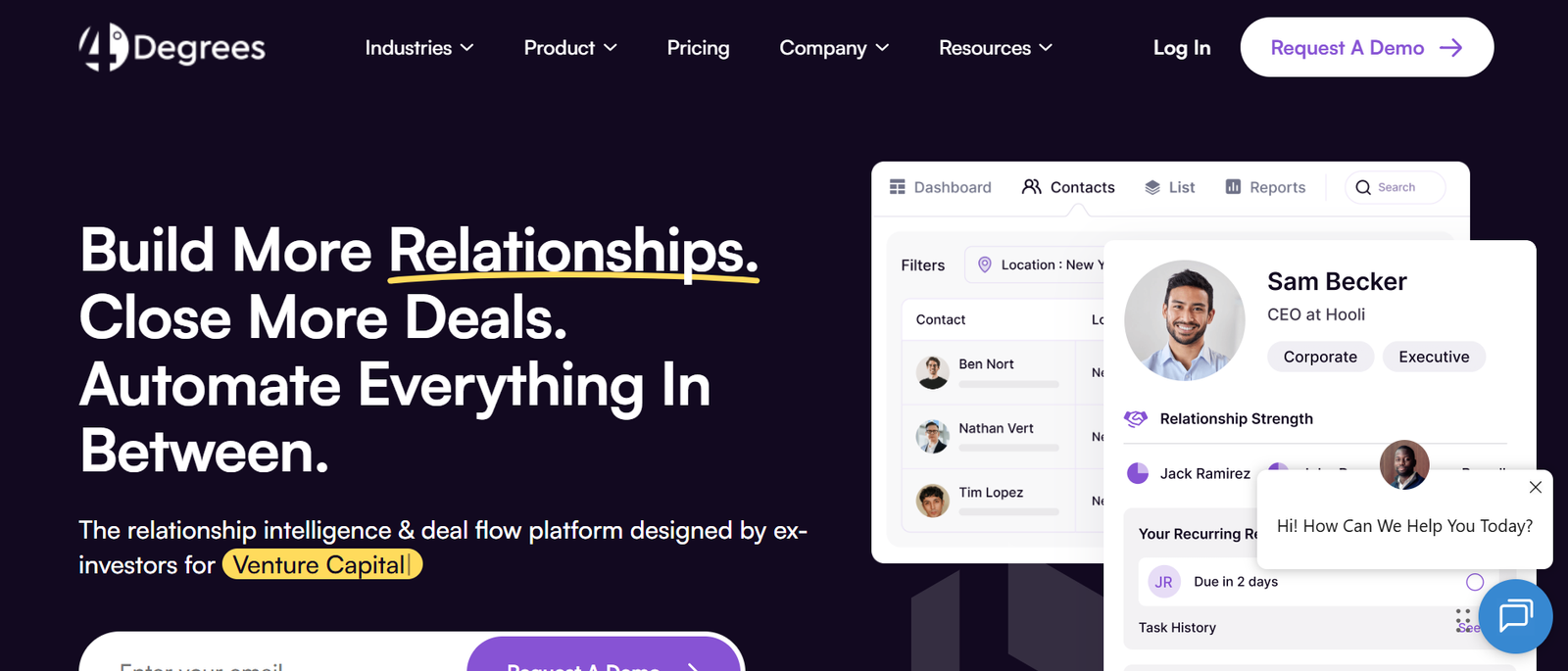
4Degrees is one of the fastest-growing Investor CRM tools among venture capital firms, private equity funds and investment banks that rely heavily on relationships.Designed around relationship intelligence rather than generic sales tracking, 4Degrees automatically captures communication data and helps investment teams prioritise warm introductions.In most 4Degrees review discussions, firms highlight ease of use and strong network visibility.
If you are comparing 4Degrees vs Affinity, the main debate centres on pricing, automation depth and enterprise scalability.Among modern Investor CRM tools built specifically for investors, 4Degrees has carved out a strong position.
Key Features
Automated Email and Calendar Sync
4Degrees integrates directly with email and calendar platforms to log communications automatically.This reduces manual input and ensures investor touchpoints are consistently recorded. In most 4Degrees review summaries, automation is considered one of the most valuable 4Degrees features.
Relationship Strength Scoring
The platform analyses frequency and depth of interactions to assess relationship strength.For VC firms prioritising warm introductions, this makes 4Degrees one of the more intelligent Investor CRM tools for pipeline prioritisation.
Deal Flow Tracking
4Degrees allows structured pipeline management across sourcing, screening, due diligence and investment committee stages.Compared in 4Degrees vs Affinity discussions, the workflow design is often viewed as slightly more intuitive for smaller funds.
Network Visibility
Teams can see who knows whom across the firm, helping partners coordinate outreach.For multi-partner funds, this eliminates duplicated efforts.
Reporting and Analytics
4Degrees provides dashboards for pipeline health, deal velocity and relationship engagement.While not as customisable as Salesforce, reporting is sufficient for most mid-sized funds.
Pros & Cons
| Pros | Cons |
| Strong relationship scoring | Premium tier pricing |
| Easy to use | Less enterprise customisation |
| Automated data capture | Limited LP modules |
| VC-focused workflows | Not ideal for founders |
Pricing
4Degrees pricing is positioned in the premium investor-focused range but typically below enterprise-heavy systems like Salesforce or DealCloud.
Costs vary based on:
- Number of team members
- Integration needs
- Reporting depth
- Support level
When reviewing 4Degrees pricing vs Affinity pricing, smaller venture firms often find 4Degrees slightly more accessible.
Best For Mid-Sized VC and Growth Equity Teams
4Degrees is particularly suited to:
- Relationship –-heavy sourcing models
- VC firms — Warm intro prioritisation
- Growth funds — Structured pipeline visibility
- Deal teams — Relationship coordination
- Investment banks — Network mapping
Verdict: If relationships drive your investment model, 4Degrees is one of the most focused Investor CRM tools for managing network-driven deal flow.
Pro Tip
Most firms use 4Degrees purely for sourcing.However, you can apply relationship scoring to LP outreach as well. Segment investors by:
- Warm introductions
- Previous engagement
- Referral sources
- Event interactions
This ensures your fundraising pipeline becomes more data-driven rather than purely reactive.
Best Alternate Tool
If you require deeper LP management and enterprise-level reporting, Affinity is often compared in 4Degrees vs Affinity discussions.
Salesforce – Enterprise-Grade CRM for Large Investment Firms
Salesforce is not built exclusively for investors, yet it remains one of the most powerful Investor CRM tools for large venture capital firms, private equity houses and institutional asset managers.Highly customisable and deeply scalable, Salesforce can be configured to manage deal flow, LP relationships, fundraising cycles and portfolio reporting.
In most Salesforce review discussions within investment firms, flexibility and reporting power are the main strengths.If you are comparing Salesforce vs Affinity or Salesforce vs DealCloud, the key difference is customisation depth versus out-of-the-box investor workflows.Among enterprise-level Investor CRM tools, Salesforce is the heavyweight.
Key Features
Fully Customisable Deal Pipelines
Salesforce allows investment teams to design deal flow stages customized their exact process.For private equity firms with complex due diligence workflows, this flexibility makes Salesforce one of the most adaptable Investor CRM tools available.
In many Salesforce review summaries, custom pipeline architecture is cited as a core strength.
LP and Fundraising Management
Funds can create separate pipelines for capital raising, tracking:
- Prospect LPs
- First meetings
- Due diligence requests
- Soft commitments
- Final closes
Compared in Salesforce vs Affinity discussions, Salesforce offers deeper custom LP segmentation.
Advanced Reporting and Dashboards
Salesforce provides powerful analytics tools, allowing firms to monitor:
- Deal conversion rates
- Fundraising velocity
- Portfolio company updates
- Partner performance metrics
For institutional investors, reporting depth is often the deciding factor.
Integration Ecosystem
Salesforce integrates with email, accounting software, portfolio monitoring tools and marketing automation systems.For large firms operating across multiple systems, this connectivity reduces operational silos.
Automation and Workflow Rules
Teams can automate reminders, approval processes and compliance tracking.This is particularly useful for regulated funds managing internal governance workflows.
Pros & Cons
| Pros | Cons |
| Highly customisable | Complex setup |
| Enterprise reporting | Expensive |
| Scalable for large funds | Requires admin expertise |
| Strong integrations | Overkill for small firms |
Pricing
Salesforce pricing varies widely depending on:
- Licence tier
- Number of users
- Add-ons and integrations
- Custom development work
Compared with other Investor CRM tools, Salesforce can become expensive once customisation and consulting fees are included.When reviewing Salesforce pricing vs DealCloud pricing, both sit at the higher end of the institutional CRM market.
Best For Institutional Funds and Large Investment Teams
Salesforce is particularly suited to:
- Institutional — fund administrators
- PE firms — Complex deal structuring
- Global VCs — Multi-team coordination
- Asset managers — Detailed LP segmentation
- Institutional funds — Governance automation
Verdict: If your firm requires deep reporting, strict compliance workflows and multi-fund oversight, Salesforce is one of the most robust Investor CRM tools on the market.
Pro Tip
One common mistake in Salesforce implementations is merging deal sourcing and LP fundraising into a single workflow.Instead, create:
- Deal pipeline
- Fundraising pipeline
- Portfolio monitoring board
Segmenting processes keeps reporting cleaner and improves capital visibility.
Best Alternate Tool
If you want enterprise capability specifically built for private markets rather than custom configuration, DealCloud is often compared in Salesforce vs DealCloud discussions.
HubSpot CRM – Free, Scalable CRM for Founders Raising Capital
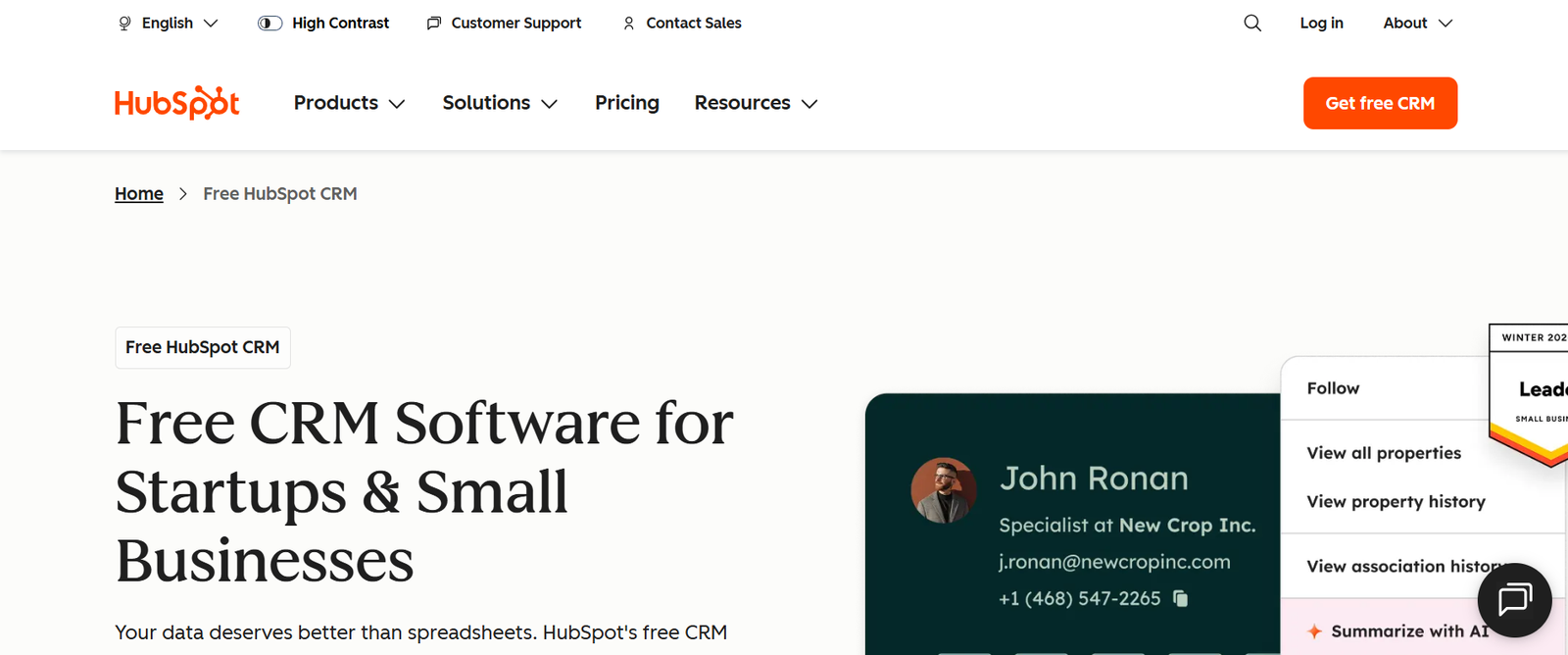
HubSpot CRM is one of the most widely used Investor CRM tools among startup founders, early-stage funds and small investment teams.While not built exclusively for investors, its free tier, intuitive interface and marketing automation features make it popular for managing fundraising pipelines.In most HubSpot CRM review discussions within startup circles, ease of use and strong integrations are the main selling points.
If you are comparing HubSpot CRM vs Salesforce or HubSpot CRM vs Pipedrive, the key difference lies in simplicity and cost structure.Among entry-level Investor CRM tools, HubSpot CRM is often the starting point.
Key Features
Fundraising Pipeline Management
HubSpot allows you to build custom pipelines to track investor conversations from:
- Initial outreach
- Intro call
- Follow-up
- Due diligence
- Term sheet
- Closed
For founders raising capital, this makes HubSpot one of the most accessible Investor CRM tools available.Many HubSpot CRM review summaries praise the drag-and-drop pipeline builder.
Email Tracking and Automation
HubSpot integrates with email platforms to track opens, clicks and replies.This is especially useful when running structured investor outreach campaigns.Compared in HubSpot CRM vs Pipedrive discussions, HubSpot’s automation is often viewed as more marketing-driven.
Contact Segmentation
You can tag investors by:
- Angel
- VC
- Family office
- Sector focus
- Geography
Segmentation is essential when customizing investor messaging.
Reporting Dashboards
HubSpot offers clean dashboards showing:
- Pipeline value
- Conversion rates
- Outreach performance
While not as deep as Salesforce, reporting is more than sufficient for most founders.
Marketing and Newsletter Tools
For funds sending LP updates, HubSpot’s email marketing tools are a major advantage over other Investor CRM tools.
Pros & Cons
| Pros | Cons |
| Free tier available | Not investor-specific |
| Easy to use | Limited advanced LP tools |
| Strong automation | Less suited for large funds |
| Clean interface | Can become costly with upgrades |
Pricing
HubSpot CRM offers:
- Free CRM plan
- Paid Sales Hub tiers
- Marketing automation add-ons
HubSpot pricing scales based on:
- Number of users
- Automation features
- Reporting needs
Compared with other Investor CRM tools, HubSpot is often the most cost-effective starting point.When reviewing HubSpot CRM pricing vs Salesforce pricing, the difference is significant, particularly for early-stage teams.
Best For Startup Founders and Small Funds
HubSpot CRM is particularly suited to
- Founders — Structured investor outreach
- Solo GPs — Affordable pipeline management
- Angel groups — Clean contact tracking
- Small funds — Simple reporting dashboards
Verdict: If you need a straightforward system to manage fundraising without enterprise complexity, HubSpot CRM is one of the most practical Investor CRM tools to start with.
Pro Tip
Many founders mix customer sales and investor outreach inside one pipeline.Instead:
- Build a dedicated fundraising board
- Track investor engagement stages
- Set automated follow-up reminders
- Use email tracking to monitor interest
This keeps your capital raise organised and investor conversations professional.
Best Alternate Tool
If you prefer a sales-focused CRM with stronger visual pipeline simplicity, Pipedrive is often compared in HubSpot CRM vs Pipedrive discussions.
Pipedrive – Visual Pipeline CRM for Fundraising Simplicity
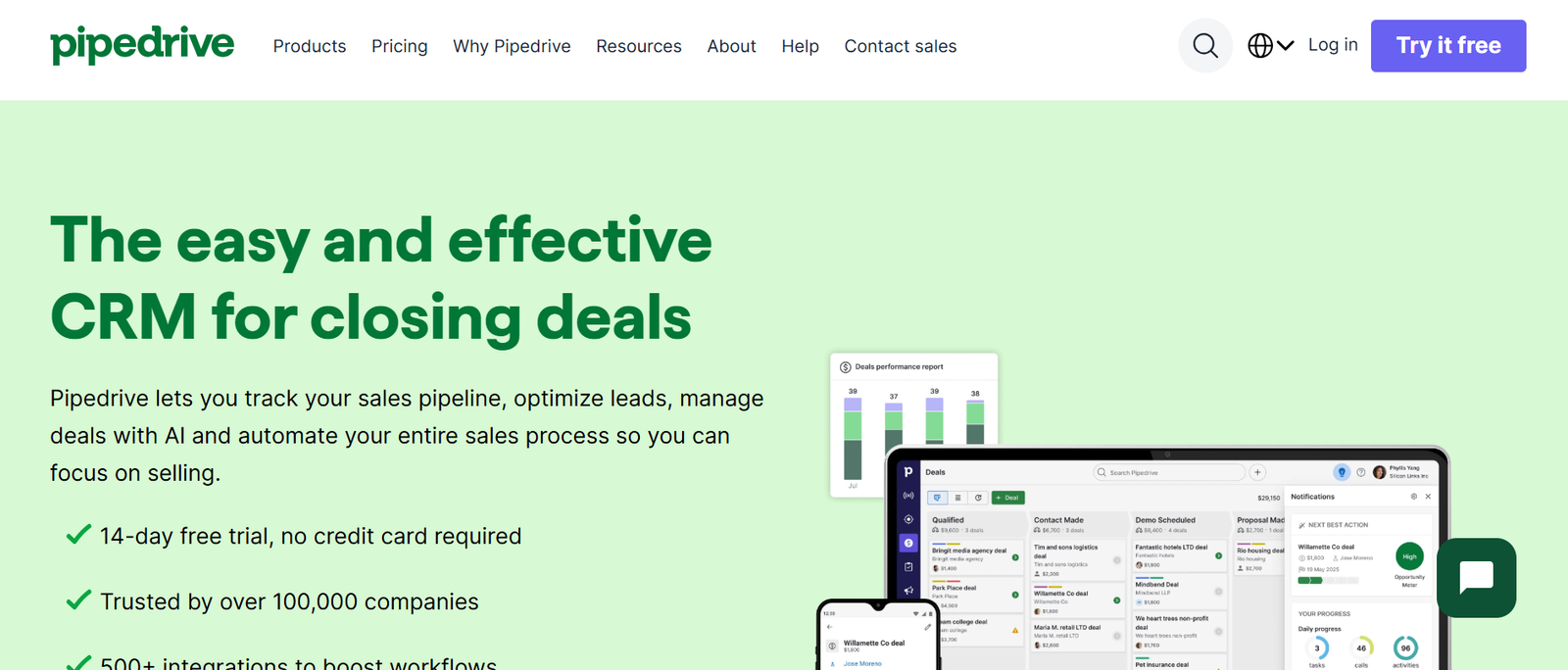
Pipedrive is one of the most intuitive Investor CRM tools for founders, angel investors and small venture teams who want a clean, visual way to track capital raising.Originally designed for sales teams, Pipedrive’s pipeline-first design makes it ideal for managing investor conversations without complexity.
In most Pipedrive review discussions among founders, ease of use and visual clarity are consistently highlighted.If you are comparing Pipedrive vs HubSpot CRM or Pipedrive vs Zoho CRM, the main difference lies in pipeline simplicity versus broader automation features.
Key Features
Visual Fundraising Pipeline
Pipedrive’s drag-and-drop interface allows you to move investors across stages such as:
- Initial contact
- Intro call
- Follow-up
- Due diligence
- Term sheet
- Closed
For founders raising a seed round, this makes Pipedrive one of the easiest Investor CRM tools to implement quickly.Many Pipedrive review summaries emphasise how little training is required.
Activity and Follow-Up Tracking
You can schedule calls, reminders and follow-ups directly within each investor profile.Missed follow-ups are one of the biggest reasons rounds stall. Pipedrive minimises that risk.
Email Integration
Pipedrive integrates with major email platforms, enabling tracking of conversations inside the CRM.Compared in Pipedrive vs HubSpot CRM discussions, Pipedrive is often considered more smooth but less marketing-focused.
Custom Fields and Tags
You can segment investors by:
- Angel or VC
- Sector focus
- Geography
- Ticket size
- Warm intro source
Segmentation improves outreach precision.
Reporting and Forecasting
Pipedrive provides basic forecasting tools to estimate round progress based on probability stages.While not as advanced as Salesforce, it is sufficient for most early-stage teams.
Pros & Cons
| Pros | Cons |
| Extremely easy to use | Not investor-specific |
| Affordable pricing | Limited LP modules |
| Strong visual pipeline | Basic reporting |
| Quick setup | Fewer automation tools |
Pricing
Pipedrive pricing is tiered and typically affordable compared with institutional Investor CRM tools.
Costs vary based on:
- Number of users
- Automation features
- Reporting add-ons
When reviewing Pipedrive pricing vs HubSpot pricing, both are competitive at entry level, but HubSpot’s free tier may appeal to very early-stage founders.
Best For Early-Stage Founders Raising Seed or Series A
Pipedrive is particularly suited to:
- Founders — Clear fundraising visibility
- Angel investors — Simple deal tracking
- Solo GPs — Lightweight pipeline control
- Small teams — Fast onboarding
Verdict: If you want Investor CRM tools that are simple, visual and quick to deploy, Pipedrive delivers clarity without enterprise complexity.
Pro Tip
To make Pipedrive more powerful for fundraising:
- Assign probability percentages to each stage
- Estimate expected cheque sizes
- Track weighted pipeline value
This turns your CRM into a capital forecasting tool rather than just a contact tracker.
Best Alternate Tool
If you need deeper relationship intelligence and automated network mapping, Affinity is often compared in Pipedrive vs Affinity discussions.
Dynamo – Private Equity CRM Built for Capital Markets
Dynamo is one of the most specialised Investor CRM tools designed specifically for private equity, venture capital and alternative asset managers.Unlike general CRMs retrofitted for investors, Dynamo is built around fund management workflows, including deal tracking, LP management and portfolio monitoring.In most Dynamo review discussions, institutional users highlight compliance readiness and fund lifecycle management as key strengths.
If you are comparing Dynamo vs DealCloud or Dynamo vs Salesforce, the core difference lies in private markets focus versus broader CRM flexibility.Among institutional Investor CRM tools, Dynamo is positioned firmly in the private equity segment.
Key Features
Private Equity Deal Flow Management
Dynamo provides structured pipelines customized for:
- Deal sourcing
- Screening
- Due diligence
- Investment committee
- Closing
For PE firms handling complex transactions, this makes Dynamo one of the more purpose-built Investor CRM tools available.Many Dynamo review summaries highlight industry-specific workflow templates.
LP and Fundraising Tracking
Funds can manage capital raising cycles with structured LP pipelines, tracking commitments and capital calls.Compared in Dynamo vs Salesforce discussions, Dynamo often requires less custom development for private markets use.
Portfolio Monitoring
Dynamo includes tools for tracking portfolio company performance, valuations and reporting metrics.This extends beyond fundraising and into long-term fund oversight.
Compliance and Audit Support
For regulated asset managers, Dynamo provides built-in compliance tracking and document management.This is a significant advantage for FCA-regulated firms in the UK.
Reporting and Analytics
Advanced dashboards support:
- Fund performance reporting
- LP engagement tracking
- Deal conversion rates
- Portfolio health metrics
Institutional users often cite reporting depth in Dynamo review evaluations.
Pros & Cons
| Pros | Cons |
| Built for private markets | Premium pricing |
| LP and portfolio modules | Less suited for founders |
| Compliance-ready | Implementation time |
| Strong reporting | Enterprise-focused |
Pricing
Dynamo pricing is typically customised based on:
- Fund size
- Assets under management
- User licences
- Required modules
Compared with lightweight Investor CRM tools like Pipedrive or HubSpot, Dynamo sits at the institutional end of the market.When reviewing Dynamo pricing vs DealCloud pricing, both are positioned for serious private equity operators.
Best For Private Equity and Institutional Asset Managers
Dynamo is particularly suited to:
- PE firms — Structured transaction tracking
- Multi-fund managers — Centralised LP oversight
- Asset managers — Compliance workflows
- Institutional investors — Portfolio reporting
Verdict: If you operate in private equity or alternative assets and need fund lifecycle management, Dynamo is one of the most detailed Investor CRM tools available.
Pro Tip
Many firms overload one dashboard with everything.Instead, configure:
- Deal sourcing pipeline
- Fundraising pipeline
- Portfolio performance dashboard
This keeps reporting clean and prevents capital raising metrics from being buried under transaction data.
Best Alternate Tool
If you require similar private markets functionality with heavier custom analytics and broader institutional adoption, DealCloud is often compared in Dynamo vs DealCloud discussions.
DealCloud – Institutional CRM for Private Capital Market
DealCloud is one of the most established Investor CRM tools in the private capital ecosystem, widely used by private equity firms, venture capital platforms, investment banks and family offices.Designed specifically for private markets, DealCloud combines deal management, LP tracking and portfolio monitoring into a single configurable platform.In most DealCloud review discussions, institutional users highlight its reporting depth and private markets alignment.
If you are comparing DealCloud vs Dynamo or DealCloud vs Salesforce, the conversation usually centres on scalability, reporting flexibility and integration capability.Among enterprise-grade Investor CRM tools, DealCloud is considered a market leader.
Key Features
End-to-End Deal Flow Management
DealCloud allows firms to manage the full lifecycle of a transaction, from sourcing to exit.Workflows can be customised for:
- Origination
- Screening
- Due diligence
- Investment committee
- Legal closing
This makes it one of the most complete Investor CRM tools for complex deal environments.Many DealCloud review summaries emphasise workflow flexibility as a defining advantage.
LP and Fundraising Modules
DealCloud supports structured fundraising tracking, including:
- Prospective LP outreach
- Commitment tracking
- Capital call monitoring
- Distribution reporting
Compared in DealCloud vs Dynamo discussions, both offer strong LP modules, but DealCloud is often viewed as more configurable at scale.
Portfolio and Performance Monitoring
Investment teams can track:
- Portfolio KPIs
- Valuation updates
- Exit timelines
- Board reporting
This creates a centralised operational hub for fund managers.
Advanced Reporting and Dashboards
DealCloud’s reporting engine allows granular data analysis across funds, sectors and geographies.Institutional investors often choose it specifically for data-driven oversight.
Integration Ecosystem
DealCloud integrates with accounting software, data providers and compliance systems.For large firms managing multiple technology stacks, this integration reduces operational friction.
Pros & Cons
| Pros | Cons |
| Built for private capital | Premium pricing |
| Highly configurable | Implementation complexity |
| Strong LP modules | Overkill for small teams |
| Deep reporting tools | Requires training |
Pricing
DealCloud pricing is customised and typically aligned with institutional budgets.Costs depend on:
- Assets under management
- Number of users
- Required modules
- Data integrations
Compared with lighter Investor CRM tools such as HubSpot or Pipedrive, DealCloud is firmly positioned in the enterprise category.When reviewing DealCloud pricing vs Salesforce pricing, both are premium options, but DealCloud requires less private market customisation.
Best For Institutional Private Equity and Large VC Firms
DealCloud is particularly suited to
- Family offices — with active portfolios
- PE firms — Complex transaction oversight
- Venture platforms — Multi-team collaboration
- Investment banks — Deal origination tracking
- Family offices — Portfolio centralisation
Verdict: If your firm operates at institutional scale and needs a centralised private markets system, DealCloud is one of the most powerful Investor CRM tools available.
Pro Tip
Many firms underutilise DealCloud’s custom data capabilities.Create structured fields for:
- IC vote outcomes
- Risk ratings
- Sector theses alignment
- Valuation benchmarks
This turns your CRM into an internal investment intelligence system rather than just a pipeline tracker.
Best Alternate Tool
If you want similar institutional functionality but with slightly more out-of-the-box private equity templates, Dynamo is often compared in DealCloud vs Dynamo discussions.
Zapflow – Scalable CRM for Private Equity and VC Teams
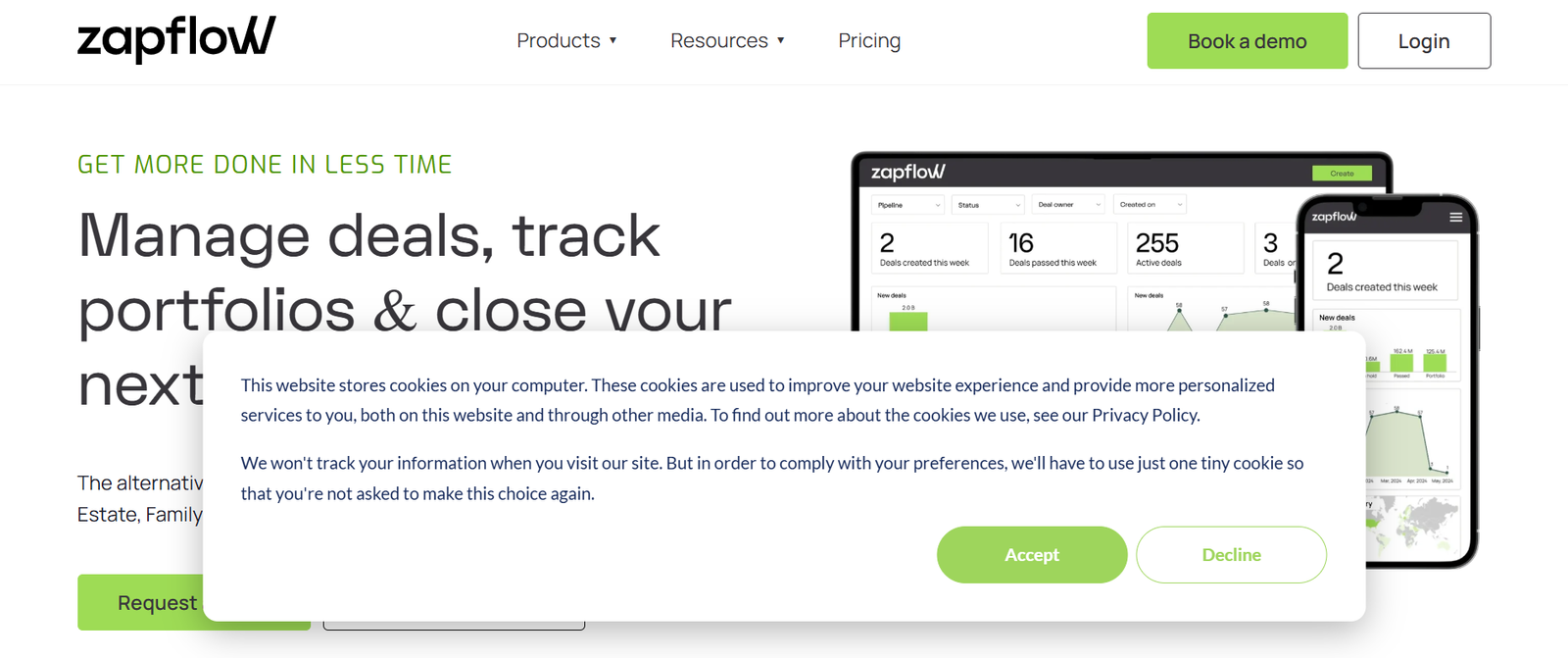
Zapflow is one of the more modern Investor CRM tools designed specifically for private equity and venture capital firms that want structured deal flow management without the heavy complexity of legacy systems.Built for private markets, Zapflow combines deal tracking, LP management and reporting in a clean, configurable interface.
In most Zapflow review discussions, users highlight flexibility and faster implementation compared with older institutional platforms.If you are comparing Zapflow vs DealCloud or Zapflow vs Dynamo, the core difference often comes down to implementation time and user experience.Among mid-to-large fund Investor CRM tools, Zapflow sits between enterprise depth and usability.
Key Features
Structured Deal Flow Management
Zapflow allows firms to build custom pipelines covering:
- Origination
- Screening
- Due diligence
- Investment committee
- Closing
For private equity teams managing multiple parallel transactions, this makes Zapflow one of the more structured Investor CRM tools available.Many Zapflow review summaries emphasise intuitive workflow design.
LP and Fundraising Tracking
Zapflow includes capital raising modules that track:
- Prospective LP engagement
- Commitment stages
- Capital calls
- Investor communications
Compared in Zapflow vs DealCloud discussions, Zapflow is often considered quicker to configure for fundraising workflows.
Portfolio Monitoring
Firms can track portfolio company KPIs and reporting metrics within the same platform.This creates operational continuity between deal execution and post-investment management.
Automation and Task Management
Zapflow supports automated reminders, task assignments and approval flows.For regulated UK funds, this improves governance and accountability.
Reporting and Dashboards
Advanced analytics allow monitoring of:
- Deal conversion rates
- Fundraising progress
- Sector allocation
- Portfolio performance
In many Zapflow review analyses, reporting flexibility is cited as a key strength.
Pros & Cons
| Pros | Cons |
| Built for private markets | Premium pricing |
| Faster implementation than legacy systems | Less brand recognition |
| Strong LP modules | May exceed small fund needs |
| Clean user interface | Custom pricing |
Pricing
Zapflow pricing is typically customised based on:
- Number of users
- Fund size
- Required modules
- Integration complexity
Compared with enterprise-heavy Investor CRM tools such as DealCloud, Zapflow is often viewed as more agile, though still premium in cost.
When reviewing Zapflow pricing vs Dynamo pricing, both target serious private market operators rather than early-stage founders.
Best For Mid to Large Private Equity and Venture Firms
Zapflow is particularly suited to:
- PE firms — Structured transaction oversight
- Growth funds — Capital raising visibility
- VC teams — Clean pipeline management
- Multi-fund managers — Centralised reporting
Verdict: If your firm needs institutional-level functionality with faster deployment, Zapflow is one of the more balanced Investor CRM tools in the private capital space.
Pro Tip
Zapflow allows filtered dashboards.Create dedicated views for:
- Sector focus
- Geography
- Ticket size
- Risk level
This gives partners instant visibility into pipeline concentration and thesis alignment.
Best Alternate Tool
If you require deeper custom analytics and broader institutional adoption, DealCloud is often compared in Zapflow vs DealCloud discussions.
Attio – Modern, Flexible CRM for Venture Teams
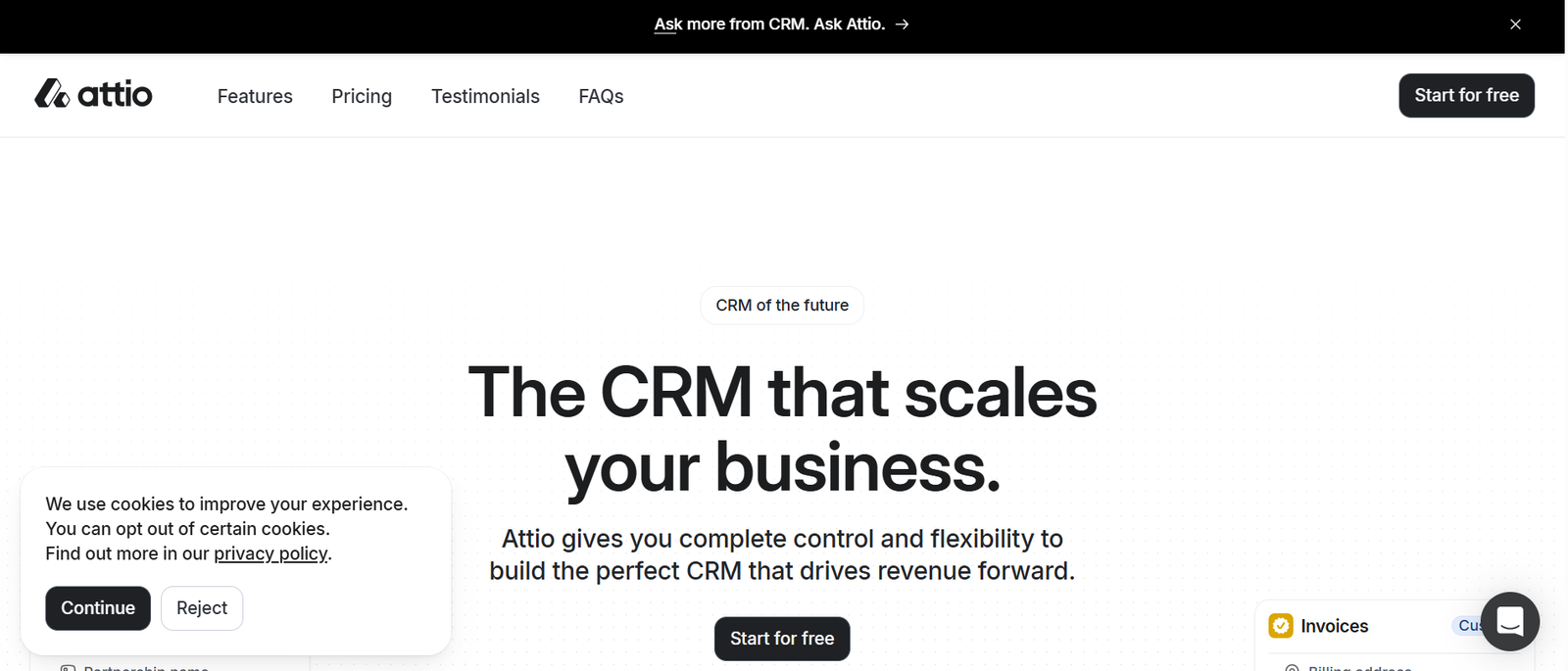
Attio is one of the newer generation Investor CRM tools gaining traction with modern venture capital firms and tech-forward investment teams.Built with flexibility at its core, Attio combines custom data modelling with a clean interface, making it attractive for funds that want structure without legacy complexity.In most Attio review discussions, users highlight adaptability and collaborative workflows.
If you are comparing Attio vs Affinity or Attio vs HubSpot CRM, the debate usually centres on relationship intelligence versus custom database flexibility.Among agile Investor CRM tools, Attio is increasingly popular with early-stage and mid-sized VC firms.
Key Features
Fully Customisable Data Models
Attio allows you to create custom object types beyond simple contacts and companies.For venture firms tracking:
- Founders
- Co-investors
- LPs
- Portfolio companies
- Introducers
This makes Attio one of the more flexible Investor CRM tools available.Many Attio review summaries cite database customisation as a key advantage.
Collaborative Deal Pipelines
Teams can build structured pipelines for:
- Deal sourcing
- Due diligence
- Investment committee
- Fundraising
Compared in Attio vs Affinity discussions, Attio is often seen as more adaptable but less automated in relationship intelligence.
Real-Time Collaboration
Attio supports live updates, shared notes and collaborative tagging.For distributed VC teams, this ensures all partners have up-to-date deal visibility.
Email and Calendar Integration
Like other modern Investor CRM tools, Attio integrates with Gmail and Outlook for contact syncing and communication tracking.
Clean, Modern Interface
Attio’s user interface is often praised for simplicity and visual clarity compared with heavier institutional systems.
Pros & Cons
| Pros | Cons |
| Highly customisable | Less automated relationship scoring |
| Modern interface | Fewer private equity templates |
| Collaborative workflows | Premium tiers required for scale |
| Flexible data structure | Not built solely for PE |
Pricing
Attio pricing includes:
- Free starter tier
- Paid plans based on users and features
- Enterprise options
Compared with enterprise investor CRM tools like DealCloud, Attio is more affordable and quicker to deploy.When reviewing Attio pricing vs HubSpot pricing, Attio is generally more customisable but less marketing-focused.
Best For Tech-Forward VC Firms and Agile Investment Teams
Attio is particularly suited to:
- VC firms — Custom pipeline modelling
- Solo GPs — Flexible data structure
- Distributed teams — Real-time collaboration
- Emerging funds — Clean interface and fast setup
Verdict: If you want modern Investor CRM tools that combine flexibility with usability, Attio offers a strong balance without institutional bloat.
Pro Tip
Instead of treating all contacts equally:
- Build distinct LP objects
- Create founder records with funding history
- Tag introducers separately
- Track co-investor relationships
This turns Attio into a relational investment intelligence system rather than a simple contact database.
Best Alternate Tool
If you prioritise automated relationship scoring and network intelligence over flexible modelling, Affinity is often compared in Attio vs Affinity discussions.
Folk – Lightweight Relationship CRM for Angel Investors
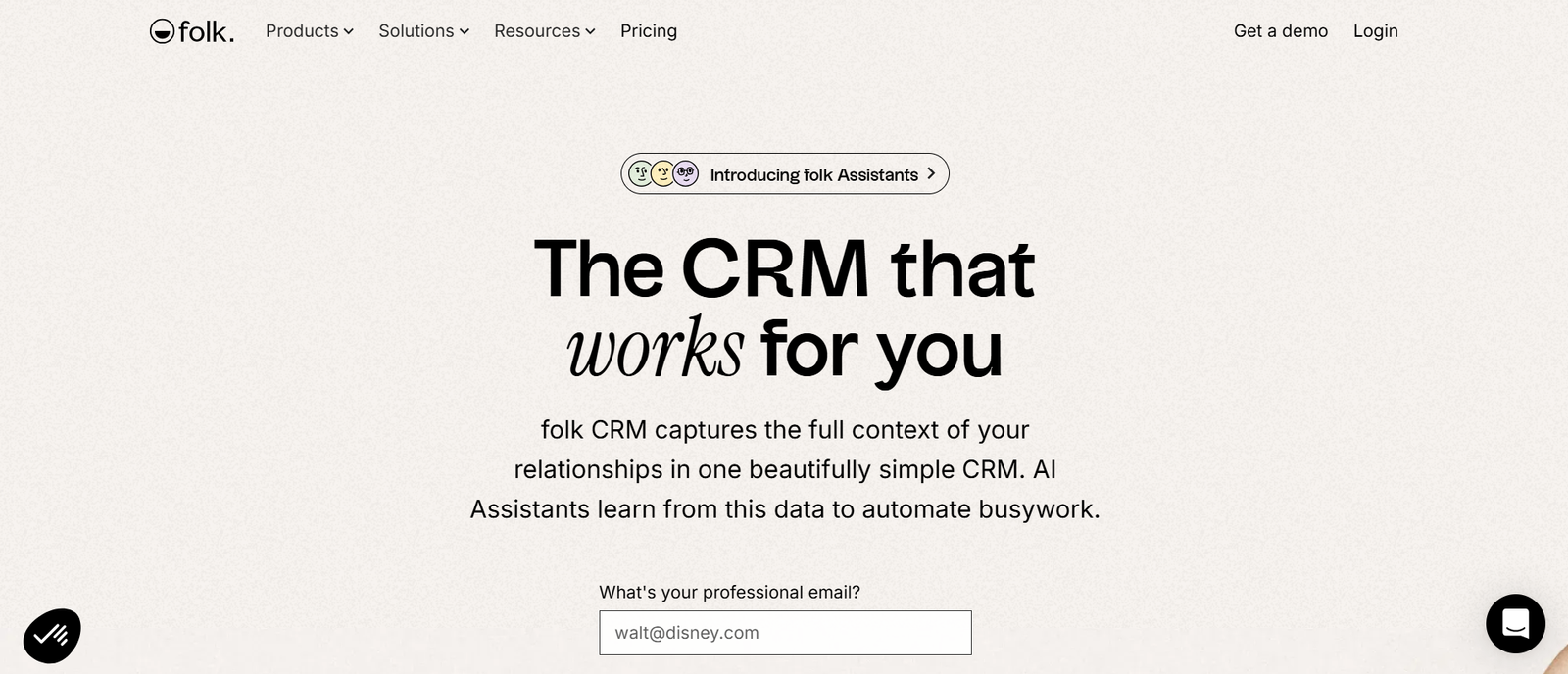
Folk is one of the simplest Investor CRM tools designed for relationship-focused users who want clarity without enterprise complexity.Popular with angel investors, syndicate leads and early-stage founders, Folk focuses on contact organisation, tagging and collaborative outreach rather than heavy private equity workflows.In most Folk review discussions, users highlight ease of use and flexible tagging as key advantages.
If you are comparing Folk vs Attio or Folk vs HubSpot CRM, the core difference lies in simplicity and relationship-first design.Among lightweight Investor CRM tools, Folk is often chosen by angel groups and smaller venture networks.
Key Features
Flexible Tagging and Segmentation
Folk allows you to tag contacts by:
- Angel
- VC
- Family office
- Sector focus
- Ticket size
- Geography
For angel syndicates coordinating multiple co-investors, this makes Folk one of the more intuitive Investor CRM tools available.
Shared Lists and Collaboration
Teams can build shared investor lists for:
- Active raises
- Follow-ups
- Warm introductions
- Event contacts
Compared in Folk vs Attio discussions, Folk is often seen as simpler and more list-driven.
Email Integration
Folk integrates with Gmail to sync conversations and track communications inside the platform.For users who live inside email, this removes friction from relationship management.
Simple Pipeline Tracking
While not as advanced as private equity platforms, Folk allows basic pipeline views for tracking investor engagement stages.This works well for founders running seed or angel rounds.
Clean User Experience
Folk’s minimal interface makes onboarding quick, especially for non-technical users.Among entry-level Investor CRM tools, ease of adoption is a major strength.
Pros & Cons
| Pros | Cons |
| Very easy to use | Limited institutional features |
| Strong tagging system | Basic reporting |
| Good for small teams | Not PE-focused |
| Affordable pricing | No advanced compliance tools |
Pricing
Folk pricing is tiered and affordable compared with institutional Investor CRM tools.Costs typically depend on:
- Number of users
- Collaboration features
- Advanced integrations
When reviewing Folk pricing vs HubSpot pricing, both are competitive for small teams, but Folk is more relationship-focused rather than marketing-driven.
Best For Angel Investors and Small Venture Networks
Folk is particularly suited to:
- Angel investors — Simple co-investor tracking
- Syndicate leads — Shared outreach lists
- Founders — Clean investor segmentation
- Small teams — Fast onboarding
Verdict: If you want Investor CRM tools that prioritise relationships over enterprise complexity, Folk delivers clarity and speed.
Pro Tip
To improve fundraising outcomes:
- Create a warm intro list
- Create a cold outreach list
- Track response rates separately
- Prioritise high-engagement contacts
This simple segmentation dramatically improves follow-up efficiency.
Best Alternate Tool
If you need more custom database modelling and structured deal flow, Attio is often compared in Folk vs Attio discussions.
Streak – Gmail-Based CRM for Fundraising Inside Your Inbox
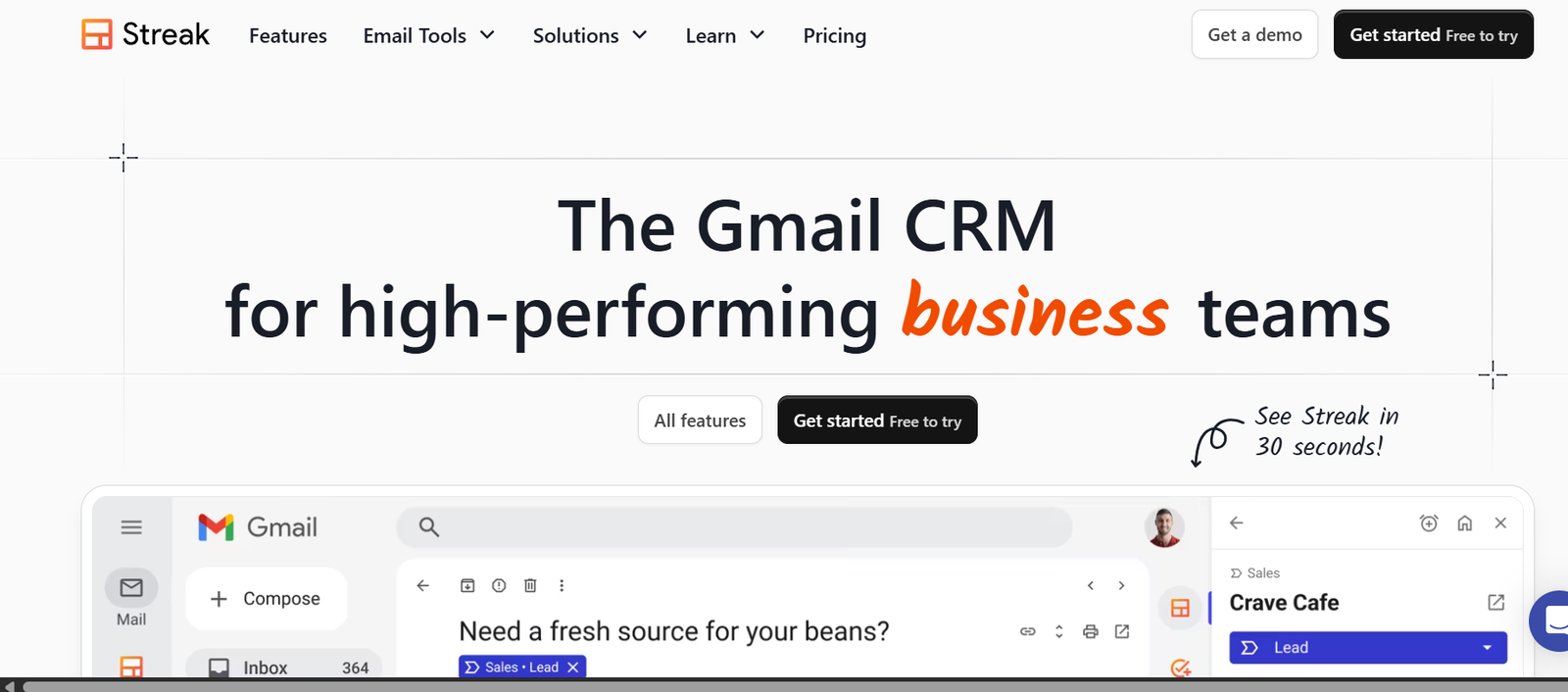
Streak is one of the most practical Investor CRM tools for founders and angel investors who manage most of their capital raising directly inside Gmail.Unlike standalone platforms, Streak operates entirely within your inbox, turning email threads into structured pipeline stages.In most Streak review discussions, users highlight convenience and zero learning curve as major advantages.
If you are comparing Streak vs HubSpot CRM or Streak vs Pipedrive, the difference lies in integration depth. Streak lives inside Gmail, while others operate as separate systems.Among lightweight Investor CRM tools, Streak is ideal for inbox-first operators.
Key Features
Gmail-Native Pipeline Tracking
Streak adds pipeline boards directly inside Gmail, allowing you to track investors through stages such as:
- Intro sent
- Call booked
- Follow-up required
- Due diligence
- Term sheet
- Closed
For founders running lean fundraising campaigns, this makes Streak one of the simplest Investor CRM tools available.Many Streak review summaries praise the seamless inbox integration.
Email Thread Linking
Every investor conversation is automatically connected to the relevant pipeline card.This removes duplication and keeps context attached to each relationship.
Reminders and Task Tracking
You can set reminders for follow-ups directly within email threads.Missed follow-ups are one of the biggest killers of investor momentum. Streak minimises that risk.
Basic Reporting
Streak provides lightweight reporting for:
- Pipeline value
- Stage distribution
- Expected close timing
While not enterprise-grade, it is sufficient for seed and angel rounds.
Custom Fields
You can add fields for:
- Ticket size
- Sector focus
- Warm intro source
- Location
- Fund type
This improves investor segmentation.
Pros & Cons
| Pros | Cons |
| Lives inside Gmail | Gmail-only |
| Very easy to use | Limited advanced reporting |
| Affordable pricing | Not private equity-focused |
| Fast setup | Basic LP management |
Pricing
Streak pricing includes:
- Free plan with limited features
- Paid tiers based on pipeline complexity
- Business plans for teams
Compared with other Investor CRM tools, Streak is one of the most affordable options for early-stage founders.When reviewing Streak pricing vs Pipedrive pricing, Streak is generally cheaper but less powerful in analytics.
Best For Inbox-First Founders and Angel Investors
Streak is particularly suited to
- Founders — Manage raise inside inbox
- Angel investors — Simple deal tracking
- Solo GPs — Minimal setup
- Small teams — No complex onboarding
Verdict: If your fundraising already happens inside Gmail, Streak is one of the most frictionless Investor CRM tools you can deploy immediately.
Pro Tip
Many founders mix investor and customer pipelines.Instead:
- Create one fundraising board
- Create one sales board
- Track engagement separately
- Set automated reminders for investor follow-ups
This keeps capital raising clean and professional.
Best Alternate Tool
If you need broader platform access beyond Gmail with more visual pipeline features, Pipedrive is often compared in Streak vs Pipedrive discussions.
Monday.com CRM – Customisable CRM for Investment Teams
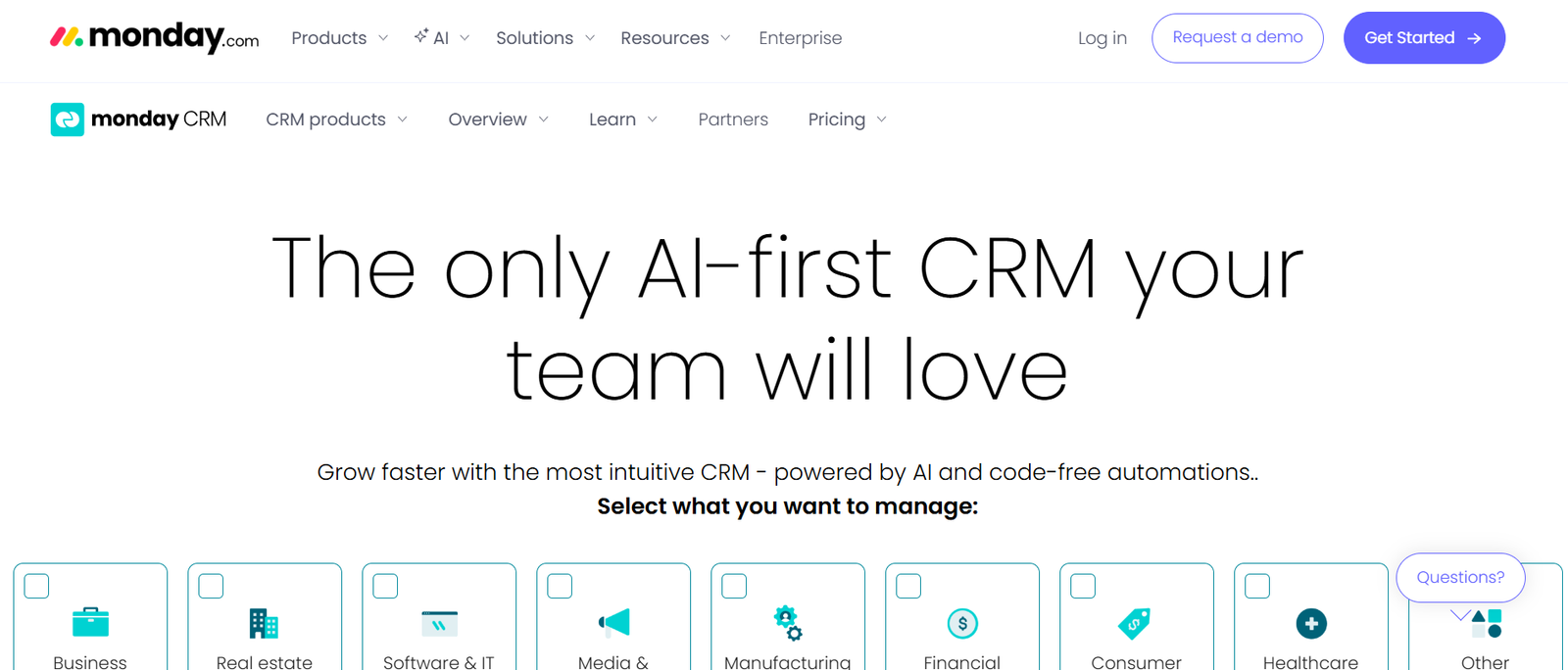
Monday CRM is part of the broader Monday.com ecosystem and is increasingly used as one of the more flexible Investor CRM tools for venture firms, angel networks and smaller private equity teams.While not purpose-built for investors, its custom board structure makes it adaptable for fundraising pipelines, LP tracking and deal flow management.
In most Monday CRM review discussions, users highlight visual dashboards and workflow flexibility.If you are comparing Monday CRM vs HubSpot CRM or Monday CRM vs Attio, the main difference lies in workflow customisation versus relationship intelligence depth.Among adaptable Investor CRM tools, Monday CRM appeals to teams that want control over process design.
Key Features
Fully Customisable Deal Boards
Monday CRM allows you to build custom boards for:
- Deal sourcing
- Due diligence
- Investment committee
- Fundraising
- Portfolio tracking
For teams with unique workflows, this makes Monday one of the more flexible Investor CRM tools available.Many Monday CRM review summaries praise its visual clarity.
Automation Rules
You can automate:
- Stage changes
- Task assignments
- Follow-up reminders
- Status notifications
Compared in Monday CRM vs HubSpot discussions, Monday is often seen as more operationally focused.
Dashboard Reporting
Monday provides visual dashboards to monitor:
- Pipeline value
- Fundraising progress
- Task completion
- Partner activity
While not as advanced as institutional systems like DealCloud, reporting is sufficient for most emerging funds.
Team Collaboration
Partners can comment, tag and update deals in real time.For distributed investment teams, this improves internal communication.
Integration Ecosystem
Monday integrates with email platforms, Slack and document storage tools.This helps centralise investor communications.
Pros & Cons
| Pros | Cons |
| Highly visual | Not investor-specific |
| Flexible workflows | Limited LP modules |
| Good team collaboration | Basic compliance tools |
| Moderate pricing | Reporting not institutional-grade |
Pricing
Monday CRM pricing is tiered and depends on:
- Number of users
- Automation features
- Reporting depth
Compared with enterprise investor CRM tools such as Salesforce or DealCloud, Monday is significantly more affordable.When reviewing Monday CRM pricing vs HubSpot pricing, costs are similar at mid-tier levels, but Monday focuses more on workflow management.
Best For Small to Mid-Sized VC and Angel Teams
Monday CRM is particularly suited to:
- VC firms — Custom pipeline design
- Small PE teams — Task automation
- Distributed teams — Real-time collaboration
Verdict: If you want adaptable Investor CRM tools that prioritise visual clarity and team coordination, Monday CRM is a strong mid-tier option.
Pro Tip
Many teams overload a single board.Instead:
- Create a dedicated deal board
- Build a separate LP fundraising board
- Track portfolio updates independently
- Use automation for follow-ups
This keeps fundraising data separate from transaction execution.
Best Alternate Tool
If you want deeper investor-specific relationship intelligence rather than workflow flexibility, Affinity is often compared in Monday CRM vs Affinity discussions.
Copper – Google Workspace CRM for Investor Teams
Copper is one of the more smooth Investor CRM tools for funds and founders operating heavily within Google Workspace.Designed to work natively with Gmail, Google Calendar and Google Drive, Copper eliminates friction between communication and pipeline tracking.In most Copper review discussions, users highlight tight Google integration and ease of adoption.
If you are comparing Copper vs Streak or Copper vs HubSpot CRM, the primary difference lies in workspace integration depth versus broader marketing features.Among Google-first Investor CRM tools, Copper is a strong contender.
Key Features
Native Google Workspace Integration
Copper syncs directly with:
- Gmail
- Google Calendar
- Google Drive
This ensures investor conversations, meeting notes and documents are automatically linked.Many Copper review summaries cite this integration as the platform’s strongest advantage over other Investor CRM tools.
Custom Fundraising Pipelines
You can build structured pipelines for:
- Investor outreach
- First meetings
- Due diligence
- Term sheets
- Closed commitments
Compared in Copper vs HubSpot CRM discussions, Copper is often viewed as more Google-centric but less marketing-driven.
Automated Data Capture
Copper reduces manual data entry by automatically logging interactions and contacts.For small venture teams, this prevents pipeline gaps.
Activity and Task Tracking
Set reminders for follow-ups, track investor responses and assign tasks to partners.Missed follow-ups during capital raising can be costly. Copper helps avoid that.
Reporting and Forecasting
Copper offers basic reporting dashboards to monitor pipeline value and expected close dates.While not institutional-grade, reporting is sufficient for early to mid-sized funds.
Pros & Cons
| Pros | Cons |
| Deep Google integration | Not PE-specific |
| Easy to deploy | Limited LP modules |
| Clean interface | Basic analytics |
| Moderate pricing | Less suited for large funds |
Pricing
Copper pricing is tiered and based on:
- Number of users
- Automation features
- Reporting depth
Compared with enterprise investor CRM tools such as DealCloud or Dynamo, Copper is significantly more affordable.When reviewing Copper pricing vs Streak pricing, Copper generally offers more structure but at a slightly higher cost.
Best For Google-Based Venture Teams and Founders
Copper is particularly suited to:
- Founders — Structured fundraising inside Gmail
- Angel investors — Contact organisation
- VC teams — Calendar-integrated tracking
- Small funds — Quick implementation
Verdict: If your investment workflow lives inside Google Workspace, Copper is one of the most convenient Investor CRM tools you can implement quickly.
Pro Tip
Create a dedicated Google Drive folder for each investor and link it directly inside Copper.
Store:
- Pitch decks
- Data room links
- Meeting notes
- Legal documents
Best Alternate Tool
If you want a CRM that lives directly inside Gmail with lighter structure, Streak is often compared in Copper vs Streak discussions.
Capsule CRM – Simple CRM for Small Funds and Angel Groups
Capsule CRM is one of the more straightforward Investor CRM tools aimed at small venture teams, angel investors and early-stage founders who want structure without enterprise complexity.It focuses on contact management, pipeline tracking and task automation, making it suitable for lightweight fundraising and deal flow management.
In most Capsule CRM review discussions, users highlight affordability and ease of use.If you are comparing Capsule CRM vs Pipedrive or Capsule CRM vs Zoho CRM, the main difference lies in simplicity versus feature depth.Among entry-level Investor CRM tools, Capsule CRM offers a balanced middle ground.
Key Features
Fundraising Pipeline Management
Capsule CRM allows you to create custom pipelines for:
- Investor outreach
- First meetings
- Follow-ups
- Due diligence
- Commitments
For small teams, this makes Capsule one of the easier Investor CRM tools to implement without technical support.Many Capsule CRM review summaries praise the clarity of its pipeline view.
Contact and Relationship Tracking
You can log calls, emails and meeting notes under each investor profile.This centralises communication history and prevents lost context during long fundraising cycles.
Task and Reminder System
Capsule includes a built-in task manager to track follow-ups and investor deadlines.Consistent follow-up is critical in capital raising, and Capsule ensures accountability.
Tagging and Segmentation
Segment investors by:
- Fund type
- Sector interest
- Geography
- Ticket size
This improves outreach targeting and reporting.
Integrations
Capsule integrates with email systems and accounting software, creating a more unified workflow.
Pros & Cons
| Pros | Cons |
| Affordable pricing | Limited advanced analytics |
| Easy setup | Not PE-specific |
| Clean interface | Basic LP modules |
| Good for small teams | Limited automation depth |
Pricing
Capsule CRM pricing is tiered and generally affordable for small teams.
Costs vary based on:
- Number of users
- Storage requirements
- Advanced features
Compared with institutional Investor CRM tools such as DealCloud or Dynamo, Capsule is positioned firmly at the small fund and founder level.
Best For Angel Investors and Small Venture Teams
Capsule CRM is particularly suited to:
- Angel investors — Clean contact tracking
- Founders — Structured fundraising pipeline
- Small funds — Affordable CRM system
- Syndicates — Centralised investor notes
Verdict: If you need Investor CRM tools that are simple, affordable and easy to adopt, Capsule CRM is a practical option for smaller investment operations.
Pro Tip
Create tags such as:
- Warm intro
- Follow-up required
- Interested but waiting
- Strategic LP
Then filter your pipeline weekly by tag to prioritise the highest probability commitments.
Best Alternate Tool
If you want stronger visual pipeline management and more sales-oriented forecasting, Pipedrive is often compared in Capsule CRM vs Pipedrive discussions.
Insightly – CRM with Project Management for Investment Teams
Insightly is one of the more versatile Investor CRM tools combining contact management, pipeline tracking and lightweight project management in a single platform.While not built specifically for venture capital or private equity, Insightly’s structured workflows make it suitable for smaller funds, angel groups and founders managing both fundraising and portfolio oversight.
In most Insightly review discussions, users highlight its balance between CRM and task management.If you are comparing Insightly vs HubSpot CRM or Insightly vs Zoho CRM, the difference usually comes down to project tracking features versus marketing automation depth.Among hybrid Investor CRM tools, Insightly offers operational flexibility.
Key Features
Fundraising and Deal Pipelines
Insightly allows you to build custom pipelines for:
- Investor outreach
- Due diligence
- Term sheet negotiation
- Closing
For emerging funds and active angel investors, this makes Insightly one of the more practical Investor CRM tools for structured capital raising.Many Insightly review summaries highlight its straightforward pipeline design.
Project Management Integration
After closing a deal, Insightly lets you convert opportunities into projects.For venture firms tracking onboarding tasks or portfolio updates, this creates continuity between fundraising and execution.
Contact Relationship Mapping
You can link founders, co-investors and LPs within the same contact ecosystem.Compared in Insightly vs HubSpot CRM discussions, Insightly is often viewed as more operationally structured.
Workflow Automation
Automate task assignments, reminders and status changes to keep investment processes moving.This reduces internal bottlenecks during due diligence.
Reporting Dashboards
Insightly offers visual reports on:
- Pipeline value
- Stage conversion
- Activity tracking
- Revenue forecasting
While not institutional-level, reporting is adequate for small to mid-sized teams.
Pros & Cons
| Pros | Cons |
| CRM + project management | Not private equity-specific |
| Moderate pricing | Limited LP modules |
| Custom workflows | Reporting less advanced than enterprise systems |
| Easy integration | May require configuration |
Pricing
Insightly pricing is tiered and depends on:
- Number of users
- Automation features
- Advanced reporting access
Compared with enterprise investor CRM tools like DealCloud or Dynamo, Insightly is more affordable and faster to deploy.When reviewing Insightly pricing vs Zoho CRM pricing, both are competitive at SME level, but Insightly offers stronger project tracking.
Best For Small Funds Managing Deals and Post-Investment Tasks
Insightly is particularly suited to:
- VC firms — Pipeline plus onboarding tracking
- Angel groups — Centralised deal visibility
- Founder-investors — Combined CRM and task management
- Small PE teams — Structured due diligence workflow
Verdict: If you want Investor CRM tools that extend beyond fundraising into light operational management, Insightly is a practical mid-tier solution.
Pro Tips
Once a deal closes:
- Convert the opportunity into a project
- Assign onboarding tasks
- Track board reporting deadlines
- Monitor milestone delivery
This keeps your CRM active beyond the fundraising phase.
Best Alternate Tool
If you want a more budget-friendly system with broader ecosystem integrations, Zoho CRM is often compared in Insightly vs Zoho CRM discussions.
Close – Sales-Driven CRM for Founder-Led Fundraising
Close is one of the more outreach-focused Investor CRM tools, designed originally for high-performance sales teams but increasingly adopted by founder-CEOs raising capital.If your fundraising strategy relies heavily on structured outbound investor outreach, Close offers built-in calling, email sequencing and pipeline tracking.In most Close review discussions, users highlight communication tools and follow-up automation as core strengths.
If you are comparing Close vs HubSpot CRM or Close vs Pipedrive, the difference usually comes down to outbound functionality versus broader marketing ecosystems.Among proactive Investor CRM tools, Close stands out for communication intensity.
Key Features
Built-In Email and Calling
Close integrates email, calling and SMS directly into the platform.For founders pitching dozens of investors weekly, this makes Close one of the most action-oriented Investor CRM tools available.Many Close review summaries emphasise how centralised communication improves follow-up consistency.
Fundraising Pipeline Tracking
Create custom pipelines for:
- Outreach sent
- Intro call
- Second meeting
- Due diligence
- Term sheet
- Closed
Compared in Close vs Pipedrive discussions, Close is often seen as more communication-heavy.
Automated Email Sequences
Close allows automated follow-up sequences for investors who have not replied.This keeps your round moving without manual chasing.
Smart Views and Filters
Segment investors by:
- Stage
- Engagement level
- Ticket size
- Sector interest
This improves prioritisation and capital forecasting.
Reporting and Activity Metrics
Track:
- Call volume
- Email response rates
- Conversion by stage
- Weighted pipeline value
For data-driven founders, this provides operational clarity.
Pros & Cons
| Pros | Cons |
| Strong outbound tools | Not investor-specific |
| Built-in calling | Limited LP modules |
| Automated follow-ups | Sales-focused design |
| Clear pipeline view | Less suited for large funds |
Pricing
Close pricing is tiered and depends on:
- Number of users
- Communication features
- Automation access
Compared with institutional Investor CRM tools like DealCloud or Dynamo, Close is far more affordable but less private equity-focused.When reviewing Close pricing vs HubSpot pricing, Close often appeals more to founder-led outreach strategies.
Best For Founders Running High-Volume Investor Outreach
Close is particularly suited to:
- Founders — Structured outbound fundraising
- Solo GPs — Communication tracking
- Angel investors — High-touch outreach
- Early-stage funds — Fast follow-up systems
Verdict: If your fundraising strategy depends on consistent outreach and follow-up, Close is one of the most action-oriented Investor CRM tools available.
Pro Tip
Instead of sending generic sequences:
- Customise by investor type
- Segment by fund stage
- Pause automation once engagement begins
- Track response timing patterns
This increases reply rates without appearing robotic.
Best Alternate Tool
If you want a more visual pipeline with lighter outbound features, Pipedrive is often compared in Close vs Pipedrive discussions.
Nimble – Relationship-Focused CRM for Investor Networking
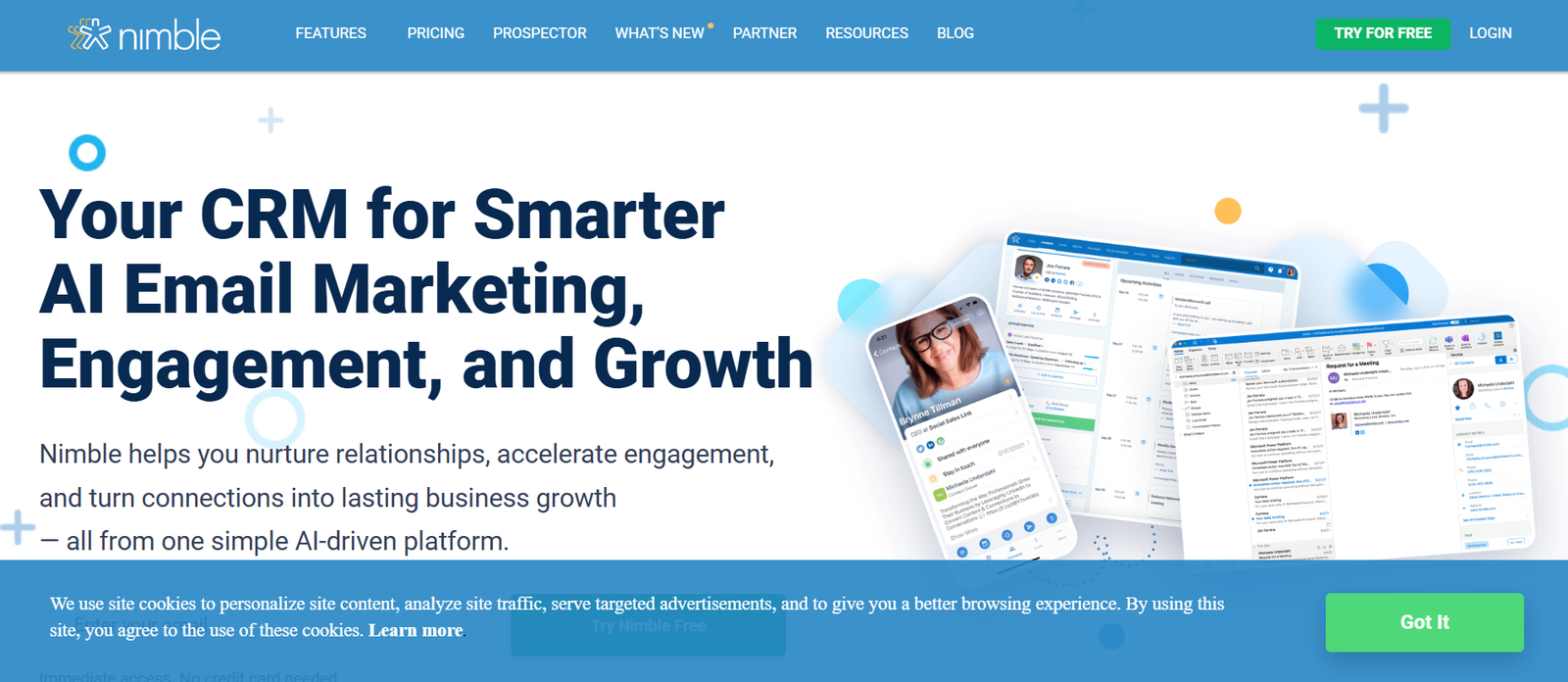
Nimble positions itself as a relationship CRM, making it one of the more networking-oriented Investor CRM tools for angel investors, syndicate leads and smaller venture teams.Rather than focusing heavily on private equity workflows, Nimble concentrates on contact enrichment and social profile integration.
In most Nimble review discussions, users highlight contact insights and simplicity.If you are comparing Nimble vs Folk or Nimble vs HubSpot CRM, the core difference lies in enrichment capabilities versus broader automation features.Among lightweight Investor CRM tools, Nimble appeals to relationship-driven operators.
Key Features
Contact Enrichment
Nimble automatically enriches contact profiles with social and company data.For angel investors building new networks, this makes Nimble one of the more insight-oriented Investor CRM tools available.Many Nimble review summaries highlight this as a major advantage.
Unified Contact Dashboard
You can see communication history, notes and profile information in one view.This helps maintain context during long fundraising cycles.
Pipeline Tracking
While simpler than private equity platforms, Nimble allows custom stages for:
- Investor outreach
- First call
- Follow-up
- Commitment
Compared in Nimble vs HubSpot CRM discussions, Nimble is seen as lighter but more relationship-centric.
Email Integration
Nimble integrates with major email systems, allowing conversation tracking.This ensures investor communications remain centralised.
Task and Reminder System
Set reminders for follow-ups and track pending actions across your pipeline.Consistent follow-up remains critical in capital raising.
Pros & Cons
| Pros | Cons |
| Strong contact enrichment | Limited PE features |
| Easy to use | Basic reporting |
| Affordable pricing | No advanced LP module |
| Good for networking | Not suited for large funds |
Pricing
Nimble pricing is typically subscription-based and affordable for individuals and small teams.
Costs depend on:
- Number of users
- Enrichment features
- Integrations
Compared with institutional Investor CRM tools like DealCloud or Dynamo, Nimble is positioned for smaller operations.When reviewing Nimble pricing vs Folk pricing, both target early-stage and networking-focused users.
Best For Angel Investors and Relationship-Heavy Fundraisers
Nimble is particularly suited to
- Angel investors — Contact enrichment
- Founders — Warm intro tracking
- Syndicate leads — Network mapping
- Solo GPs — Simple relationship oversight
Verdict: If your investment strategy revolves around introductions and networking, Nimble is one of the most relationship-focused Investor CRM tools available.
Pro Tip
Create a specific tag for introducers and track how often they refer deals or investors.Over time, this builds an internal ranking of your most valuable connectors.
Best Alternate Tool
If you want stronger structured deal pipelines rather than enrichment features, Folk is often compared in Nimble vs Folk discussions.
Zoho CRM – Budget-Friendly CRM for Emerging Investment Teams
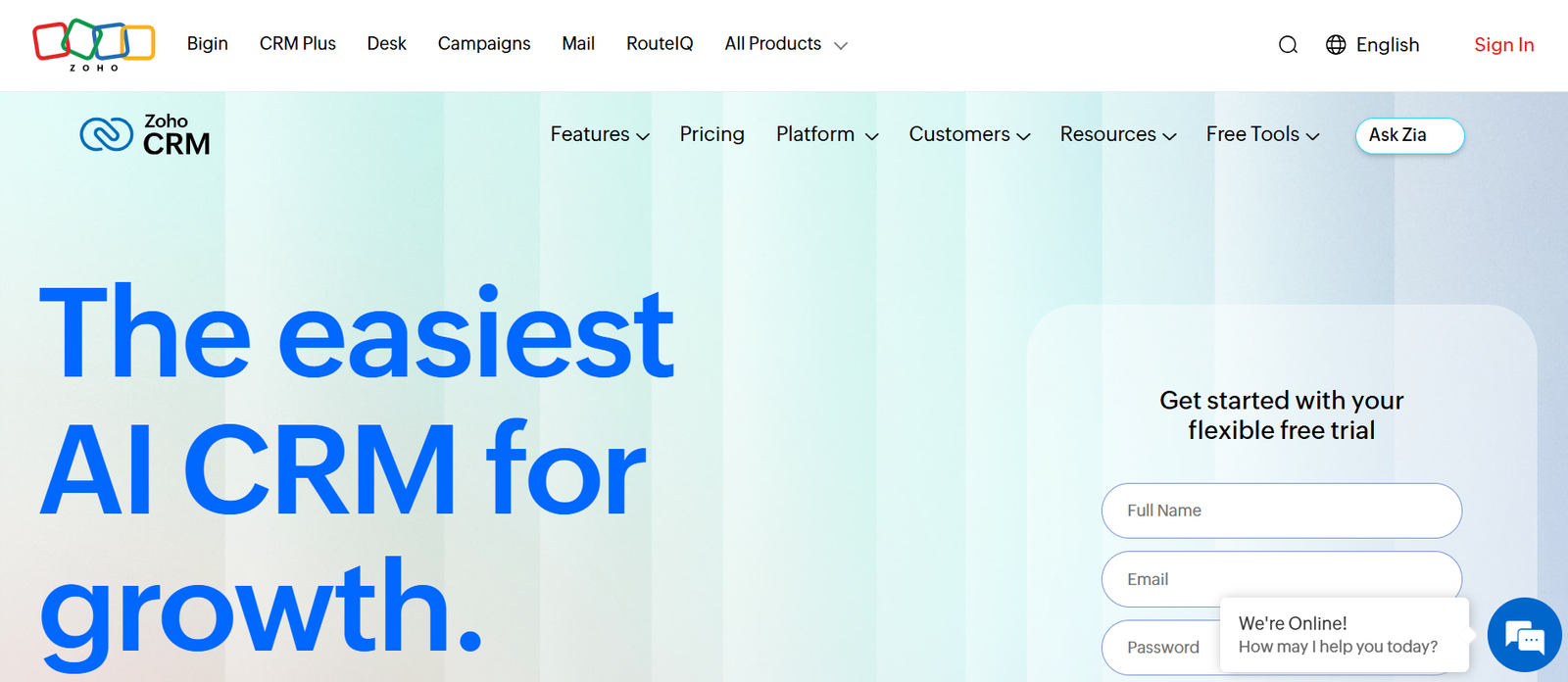
Zoho CRM is one of the more affordable Investor CRM tools for small venture funds, angel networks and founders managing structured fundraising without enterprise software costs.Although Zoho is not built exclusively for investors, its customisable pipelines and automation features make it adaptable for deal flow tracking and LP management at early stages.In most Zoho CRM review discussions, users point to pricing flexibility and ecosystem breadth.
If you are comparing Zoho CRM vs Insightly or Zoho CRM vs HubSpot CRM, the decision often comes down to cost efficiency versus marketing automation depth.Among cost-conscious Investor CRM tools, Zoho CRM remains a practical option.
Key Features
Custom Deal Pipelines
Zoho CRM allows custom stage creation for:
- Investor outreach
- First meeting
- Due diligence
- Term sheet
- Closed
For early-stage funds, this makes Zoho one of the more adaptable Investor CRM tools at SME level.Many Zoho CRM review summaries highlight pipeline flexibility.
Workflow Automation
Automate follow-ups, reminders and status updates to reduce manual admin.Compared in Zoho CRM vs HubSpot CRM discussions, Zoho is often considered more affordable but slightly less polished.
Contact Segmentation
Tag investors by:
- Sector focus
- Fund type
- Ticket size
- Geography
Segmentation improves targeting during capital raising.
Reporting Dashboards
Zoho includes visual dashboards for pipeline value and stage conversion rates.While not enterprise-grade like DealCloud, reporting is sufficient for smaller investment teams.
Integration Ecosystem
Zoho connects with accounting tools, email systems and document storage platforms.This centralises operations across your fundraising workflow.
Pros & Cons
| Pros | Cons |
| Competitive pricing | Not investor-specific |
| Good automation | Interface less modern |
| Flexible customisation | Limited PE templates |
| Scalable tiers | Advanced features cost extra |
Pricing
Zoho CRM pricing is tiered and generally lower than most institutional Investor CRM tools.Costs vary based on:
- User count
- Automation features
- Reporting modules
When reviewing Zoho CRM pricing vs Insightly pricing, both compete strongly in the SME segment, but Zoho often wins on cost.
Best For Budget-Conscious Venture Teams
Zoho CRM is particularly suited to:
- Small funds — Structured pipeline at low cost
- Angel groups — Contact segmentation
- Founders — Affordable fundraising CRM
- Early PE teams — Workflow automation
Verdict: If budget control is a priority while maintaining structure, Zoho CRM is one of the most accessible Investor CRM tools available.
Pro Tip
Instead of mixing all contacts:
- Create LP module
- Create portfolio company module
- Assign custom fields for commitment size
- Track reporting deadlines
This keeps fundraising and post-investment management organised.
Best Alternate Tool
If you want slightly stronger project management integration alongside CRM features, Insightly is often compared in Zoho CRM vs Insightly discussions.
Freshworks Freshsales – CRM for Structured Investor Outreach
Freshsales, part of the Freshworks suite, is one of the more sales-oriented Investor CRM tools suited to founders, angel investors and small funds running organised outreach campaigns.While not built exclusively for private markets, its automation and communication tracking features make it effective for managing investor pipelines.In most Freshsales review discussions, users mention ease of use and integrated communication tools.
If you are comparing Freshsales vs Close or Freshsales vs HubSpot CRM, the main distinction lies in pricing tiers and built-in calling features.Among practical Investor CRM tools for outbound fundraising, Freshsales holds a strong position.
Key Features
Custom Fundraising Pipelines
Freshsales allows you to create custom deal stages such as
- Initial outreach
- First meeting
- Due diligence
- Investment committee
- Closed commitment
For early-stage founders, this makes Freshsales one of the more structured Investor CRM tools for pipeline clarity.Many Freshsales review summaries highlight the visual deal board.
Built-In Email and Calling
Freshsales includes email tracking and integrated calling tools.Compared in Freshsales vs Close discussions, Close may be more outbound-heavy, but Freshsales offers strong communication capabilities at competitive pricing.
Lead Scoring
Freshsales allows basic lead scoring based on engagement.This can be adapted for investor prioritisation during fundraising.
Automation Workflows
Set automated reminders for follow-ups and stage progression.Consistency is critical when managing multiple investor conversations.
Reporting Dashboards
Track:
- Pipeline value
- Conversion rates
- Engagement metrics
- Forecasted close dates
Reporting depth is suitable for SME-level funds and founder-led raises.
Pros & Cons
| Pros | Cons |
| Affordable tiers | Not PE-specific |
| Built-in calling | Limited LP modules |
| Easy setup | Less institutional reporting |
| Clean pipeline view | May require upgrades for automation |
Pricing
Freshsales pricing is tiered and competitive within SME CRM categories.Costs vary based on:
- Number of users
- Communication features
- Automation level
Compared with enterprise investor CRM tools such as DealCloud or Dynamo, Freshsales is positioned for smaller operations.When reviewing Freshsales pricing vs Close pricing, both compete strongly for outreach-focused teams.
Best For Founder-Led Capital Raising and Small Funds
Freshsales is particularly suited to:
- Founders — Structured outreach management
- Angel investors — Pipeline visibility
- Small funds — Affordable communication tracking
- Early-stage teams — Simple onboarding
Verdict: If your fundraising strategy depends on organised outreach with built-in communication tracking, Freshsales is one of the more practical Investor CRM tools for SME teams.
Pro Tip
Create filters for:
- Opened but not replied
- Replied but no meeting booked
- Meeting completed, awaiting follow-up
This keeps your fundraising disciplined and prevents stalled conversations.
Best Alternate Tool
If you want stronger automation for outbound sequences, Close is often compared in Freshsales vs Close discussions.
Pipedrive with Add-Ons – Hybrid CRM Stack for Investor Teams
Pipedrive on its own is a strong visual CRM. When combined with add-ons such as email automation tools, enrichment platforms and reporting integrations, it becomes one of the more adaptable Investor CRM tools for growing venture firms and active angel groups.Many teams start with basic Pipedrive, then layer additional tools as fundraising activity increases.
In most Pipedrive review discussions, users mention ease of use. In more advanced Pipedrive vs HubSpot CRM or Pipedrive vs Close comparisons, the conversation shifts to ecosystem flexibility.Among modular Investor CRM tools, this hybrid approach offers control without institutional pricing.
Key Features
Visual Fundraising Pipeline
Pipedrive’s drag-and-drop deal board allows tracking of:
- Investor outreach
- Intro calls
- Due diligence
- Term sheets
- Closed commitments
This makes it one of the most intuitive Investor CRM tools for founder-led raises.When reviewing Pipedrive features, the visual layout is consistently highlighted.
Add-On Integrations
Common add-ons include:
- Email automation tools
- Data enrichment services
- Reporting dashboards
- Document tracking tools
Compared in Pipedrive vs Salesforce discussions, the difference is custom stack building versus fully integrated enterprise systems.
Email Tracking and Automation
With integrations, you can monitor email opens, automate follow-ups and schedule reminders.This creates a structured outreach workflow.
Custom Fields and Investor Segmentation
Add advanced fields for:
- Ticket size
- Sector focus
- Stage preference
- Warm intro source
Segmentation increases fundraising clarity.
Forecasting and Weighted Pipeline
With add-ons, Pipedrive can track weighted capital commitments and forecast close probabilities.This turns it into a functional capital tracking system.
Pros & Cons
| Pros | Cons |
| Highly flexible | Requires setup effort |
| Affordable core pricing | Add-ons increase cost |
| Visual clarity | Not PE-specific |
| Scales gradually | Reporting depends on integrations |
Pricing
Pipedrive core pricing is affordable.However, when adding:
- Automation tools
- Reporting integrations
- Enrichment services
Total cost can increase.
When reviewing Pipedrive pricing vs HubSpot pricing, base tiers are competitive, but advanced stacks may approach mid-tier CRM pricing.Compared with institutional Investor CRM tools such as DealCloud or Dynamo, this hybrid approach remains more accessible for small to mid-sized teams.
Best For Growing VC Firms and Active Angel Syndicates
Pipedrive with add-ons is particularly suited to:
- Founders — Structured outreach stack
- Angel groups — Modular scalability
- VC firms — Gradual system build-out
- Solo GPs — Control over CRM environment
Verdict: If you want Investor CRM tools that grow with your fundraising complexity, Pipedrive combined with add-ons provides flexibility without immediate enterprise commitment.
Pro Tip
Instead of overcomplicating setup:
- Use Pipedrive for pipeline tracking
- Integrate email automation separately
- Add enrichment only if needed
- Connect reporting dashboards later
This keeps your system lean while preserving scalability.
Choosing the Right Investor CRM Tools in 2026
Managing capital raising without structure leads to missed follow-ups, unclear pipeline visibility and lost commitments.
The right Investor CRM tools bring:
- Deal flow clarity
- LP tracking discipline
- Follow-up consistency
- Reporting transparency
- Capital forecasting accuracy
Some Investor CRM tools are built for institutional private equity.Others are better suited to founders raising their first round.Your choice depends on:
- Fund size
- Capital raising frequency
- Number of partners
- Compliance requirements
- Budget
Call to Action
If you are:
- A founder preparing for seed or Series A
- A VC firm upgrading from spreadsheets
- A private equity team needing structured reporting
- An angel network managing multiple co-investors
We can assess your:
- Fundraising process
- Deal flow structure
- Reporting requirements
- LP management needs
Schedule a consultation and build an Investor CRM system that matches your investment strategy.
FAQs
1. What are Investor CRM tools used for?
Investor CRM tools manage fundraising pipelines, deal sourcing, LP tracking and investor communications.
2. Are Investor CRM tools different from sales CRMs?
Yes. While many began as sales CRMs, investor-focused platforms include deal flow management, LP modules and portfolio tracking.
3. Which Investor CRM tools are best for private equity?
DealCloud, Dynamo and Zapflow are often chosen by private equity firms.
4. What is the best Investor CRM tool for founders?
HubSpot CRM, Pipedrive and Streak are common options for early-stage founders.
5. Do Investor CRM tools integrate with email?
Most integrate with Gmail or Outlook to log communications automatically.
6. How much do Investor CRM tools cost?
Pricing ranges from free tiers for founders to enterprise-level customised pricing for institutional funds.
7. Should I use one system for deal flow and fundraising?
Yes. Keeping both inside a structured CRM improves visibility and reporting consistency.
8. Are Investor CRM tools compliant with UK regulations?
Enterprise platforms typically include compliance features suitable for FCA-regulated firms.
9. Can small angel groups use Investor CRM tools?
Yes. Lightweight tools like Folk, Nimble and Capsule CRM work well for smaller networks.
10. How do I choose the right Investor CRM tool?
Assess your fund size, capital raising frequency, reporting needs and budget before committing.